
| Now Available! Signs in the Heavens: A Muslim Astronomer's Perspective on Religion and Science |
2nd
edition revised and expanded  "This book offers information and insights into ... topics too rarely confronted in Western academic circles, particularly the spiritual foundations of modern science." --Kamran Memon, Islamic Horizons
"... A beautiful
book!"
--Ajieb Bilal,
educator
|
|
| by Imad -ad-Dean Ahmad 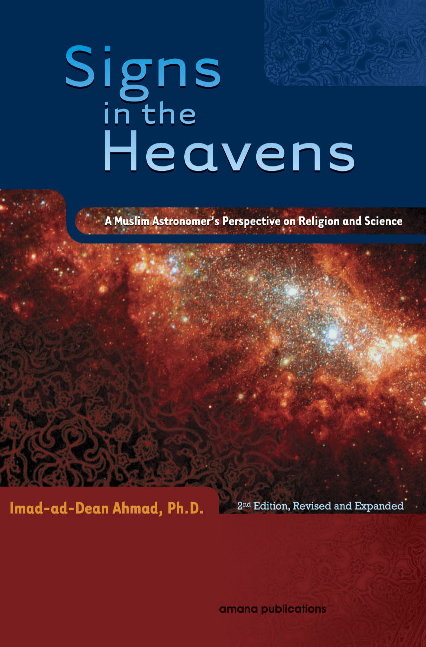 "... must reading
for all
Muslims."
--Dr.
Robert
D. Crane, Muslim author and
former White House
policy advisor
"Essential
historical and
scienific knowledge
--Imam Yusuf Saleem, Masjid Muhammad,
Washington, DCmade accessible to the common person ... An excellent book." |
Dr. Imad-ad-Dean Ahmad explodes the myth of a
contradiction
between religion and science.
The Table of Contents and the preface to the volume are
reproduced
below.
TO GET YOUR COPY send $19.95 with a request
for
Signs in the Heavens: A Muslim Astronomer's Perspective
on Religion and
Science to:
Minaret of Freedom Institute
4323 Rosedale Avenue
Bethesda, MD 20814
Bookstores, foundations, mosques, schools and other
retailers call us at 301-907-0947 for wholesale pricing.
Contents
|
Illustrations |
vii |
|
|
|
|
Acknowledgements |
xi |
|
|
|
|
Notes on Transliteration and
Qur'anic Quotes |
xii |
|
|
|
|
Preface |
xiii |
|
|
|
|
Chapter 1. Introduction |
1 |
|
|
|
|
Chapter 2. Science and Religion |
11 |
|
|
|
|
Chapter 3. The Signs of God |
48 |
|
|
|
|
Chapter 4. What Muhammad Saw
in the Sky |
66 |
|
|
|
|
Chapter 5. Missing Years in
the History of Science:
622-1492 C.E. |
70 |
|
|
|
|
Chapter 6. Impact of Islamic
Astronomy on the West |
128 |
|
|
|
|
Chapter 7. The Lunar Calendar
Problem |
141 |
|
|
|
|
Chapter 8. The Incoherence of
Muslim Pseudoscience |
154 |
|
|
|
|
Chapter 9. Prospects for an
Islamic Renaissance |
162 |
|
|
|
|
Bibliography |
184 |
|
|
|
|
Index |
194 |
Preface
The first edition of this book was written for the layman in non-technical popular language about Islam and astronomy, but it was more fundamentally about the perspective of one modern Muslim astronomer on religion and science, since only God is completely objective. This second edition is the product of a research grant from the Templeton Foundation, and has benefited from the recommendations of three distinguished scientists who have been involved in the study of the history of science. In the fourteen years intervening between the two editions the quality of the discussion of the relationship between religion and science in Islamic civilization has risen to a more sophisticated plane. Ignorant dissertations based on the false premise that the Muslim world shared in the Dark Ages of Western Civilization are less prevalent. They have been replaced by thoughtful, though sometimes polemical, queries as to why Islamic science stagnated or declined while Western science blossomed into the Industrial Revolution and exponentially accelerated into the marvelous breakthroughs in research and technology that we witness on a regulars basis today. Substantial new historical research has taken place supporting the thesis of this book so that it is now less novel than before, but, given recent world events, more important than ever. Responding to both the changing environment and to the recommendations of my colleagues, this new edition has become somewhat more academic than the first, yet still aims to be accessible to the lay reader.
In this book I present the attitudes towards science put forward in the Qur'an and the Prophetic traditions and by the great Muslim scholars of the classical era. I shall briefly review some of the scientific achievements of the golden era of Islamic civilization and in more detail discuss some important achievements in astronomy. I shall also try to show how the methodology of modern science was developed in the Islamic classical era and how advancements in science by the Muslims were the natural outgrowth of the Qur'anic foundations of Islam.
Several different topics will be addressed in this book: Prophet Muhammad's own experiences with astronomical phenomena; medieval Muslim scientific achievements; the current state of science in the Muslim world as demonstrated by confusion over the lunar calendar and the growth of Muslim pseudoscience; the harmony of faith and science in the Islamic tradition and the origin of the Western notion that these two concepts do conflict; the mounting dissatisfaction with the Ptolemaic system that led up to what we know as “the Copernican Revolution.”
Even in so dispassionate a field as physics, every scientist harbors affection for his own theories. He has a concern about what effect disproving his own previously published articles may have on future funding. Such emotions impede objectivity. Yet, objectivity still has some meaning even in the human realm.
Recently, a trend has emerged to transcend the Eurocentric bias of the Western educational establishment. To overcome that bias without replacing it with some new one is a worthwhile challenge. As a man raised with each foot in a different culture, I may be at an advantage in daring to rise to that challenge. In any case, I can think of no better project to try to bridge the gap of the European and Islamic cultures than a study of Islamic civilization's attitudes towards and contributions to science.
There are at least two themes in this book, each of which deserves a book of its own. For me, however, these themes are so closely related, that I think both deserve to be discussed together before attempting separate books to treat each in detail. Let the reader approach this book as a kind of overture to either or both of these themes or as an exploratory description of the relationship between them. The themes are: that the view that there is such a conflict between science and religion is a myth that arose from the West's unique history, and that in the classical Islamic era (when religion and science worked hand-in-hand) much progress was made in scientific research and techniques. The second of these supports the first (and main theme) by showing how a very religious culture was at the same time scientifically progressive. It is only fitting for a Muslim author to choose Islamic civilization to demonstrate this point. At the same time, candor requires a third theme, a counterpoint perhaps, that the modern Muslim world has fallen far from the golden era because Muslims have abandoned those principles and standards that made scientific progress possible. Which theme is in the fore varies as the reader progresses through the book. Perhaps, then, it will be helpful for me to outline what each chapter seeks to achieve in connection with the broader objectives of this book.
The first chapter notes that the perceived incompatibility between art and science is paralleled by the myth of an even deeper and fiercer opposition between (religious) faith and reason and that neither of these views is part of Islamic thought. An alternative view that the same God who revealed His message to the prophets gave us reason to be able to recognize His message and distinguish truth from error is put forth.
The second chapter puts forward the view that monotheism and reason are allies against pagan superstition. The demise of classical European science coincident with the incorporation of pagan elements into Western European Christianity is noted, as well as the coincidence of the rise of science in the Arabic language with the spread of Islam. The revitalization of European science at the time of its contacts with Islam is noted.
The third chapter enumerates the factors in Islam that were conducive to scientific development.
In the fourth chapter, three incidents in the life of the Prophet which may be related to the observation of astronomical events are examined to show that, despite his lack of scientific knowledge, his attitude was free from superstition and that he saw each incident as a sign of God's greatness rather than omens about mundane human affairs.
In the fifth chapter, we review some of the scientific accomplishments of the Islamic classical era with special emphasis (as befits an author who is an astronomer) on astronomy. We note that the most innovative scholars (like al-Biruni) were also the most pious.
In the sixth chapter we make some observations on the impact of Islamic science on the West. In particular, the “Great Chain of Being” and its authoritarian implications are explained. We show how Muslim astronomy eroded the foundations of the Great Chain of being and paved the way for a scientific model in which all creation is equal under God. We contrast the persecution of Galileo and Bruno with the Muslims' attitude towards scientific scholarship in the classical era. Part of the European revolt against the anti-science of the authoritarian Church splintered off into an anti-religion movement that has left its mark on modern attitudes towards the relationship between religion and science.
In the seventh chapter, we look at the issue of the Islamic calendar and note the unscientific attitude with which modern Muslims have dealt with this problem. This is considered evidence of the decline of respect for science in recent Muslim history.
In the eighth chapter, we look at the rise of modern Muslim pseudoscience that treats the Qur’an, a book of guidance, as if it were a scientific textbook. Misleadingly called “Islamic science” this phenomenon has provoked a vehement reaction that has given the term “Islamic science” such a bad reputation that some are even denying that such a thing existed in the classical era, thus obscuring the very real contributions to scientific methodology that came out of the Islamic civilization.
The idea that the Muslims' willingness or unwillingness to resolve the confusion over the Islamic calendar in a scientific rather than authoritarian manner and that modern Muslims are more enamored of pseudoscientific claims about allusions to the natural world in the Qur’an leads directly to the ninth and final chapter, in which we enumerate the impediments to Muslim scientific growth: oppressive Muslim governments, colonial remnants of the faith versus reason dichotomy, and the absence of ijtihâd (individual struggle for understanding). God does not change the condition of a people until they change themselves.
I should mention that there is a ghost that haunts this book. His name is well known to Muslims but will be unfamiliar to most non-Muslims who read this book. Yet even those who know his name are not generally familiar with the real essence of his teachings. He is Abu Hamid Muhammad ibn Muhammad at-Tusi al-Ghazali, and I wonder if ever so influential a man was so thoroughly misunderstood. He was the man who reconciled orthodox Islam and Sufism and who first understood advanced a truly modern theory of knowledge in which reason, experience, and authority were given balanced roles. Yet his teachings were so thoroughly misunderstood that instead of validating the rise of Islamic science they have been misread by non-Muslims as precipitating its decline and fall and misread by Muslims in a way that may have contributed to its decline and fall.
Al-Ghazali had been a rationalist and a popular teacher of the philosophical school that thought that reason alone could lead to truth. Yet, his own keen intellect led him to the realization that this was simply not true. The realization that he was a hypocrite to teach his students that unaided reason could lead to truth when in his own heart it had lead him only to skepticism caused a psychological crisis and one day he stood before his class incapable of speech. He retired from teaching and from public life. His spiritual journey, described in his book The Deliverance from Error led him to the realization that while correct reasoning from correct premises could lead to truth, reason by itself could not ascertain which premises were valid and which were not. Experience and transmitted knowledge from reliable sources were required in order to know which premises were sound and which were suspect. He saw that the rationalistic philosophers in antiquity and in the Muslim world had accepted metaphysical speculation as axioms and he debunked them in his iconoclastic book The Incoherence of the Philosophers. Similarly, he saw that the authoritarian religious establishment had fallen prey to a similar error in accepting authority as the sole source of knowledge. And the radical Sufis, too, had made the error of relying on their mystical experience alone. One could be delivered from these errors by using reason, experience, and transmission from reliable sources as checks upon one another in arriving at the truth. The evolution of Islamic science was the gradual pragmatic development of this balance in the study of nature until what had been “natural philosophy” became modern science.
By training and by profession I am an astronomer. By ancestry and by choice I am a Muslim. I believe in Islam not because it happened to have been the religion of my ancestors, but because I have read the sacred Text, considered the arguments, and I am convinced. This book is written for the general reader, yet it reflects the vantage point of a man who is a Muslim and an astronomer for, after all, such a man wrote it. The limitations that the human condition places on objectivity, however, should never prejudice one's analyses. I am always open to refutation. I always want to hear the sincere and knowledgeable arguments on the other side, whether from other religious views or from critics of certain scientific theories that I have found persuasive. That is the best mechanism by which human beings, fallible as we are, may correct our errors. The other path, that of learning by experience, is also effective, but more painful.
The same God who revealed His Message to the prophets gave us reason in order to be able to recognize His Message and to distinguish it from fraudulent and foolish claims to divine guidance. As a Muslim scholar, commanded to engage in holy struggle (jihâd) using my particular learning and skills, I must share my knowledge and understanding with others. By the grace of the one God (the God of Abraham and Jacob, Moses and Jesus, and Adam and Muhammad, peace be upon them all, and Who is called Allah in the Arabic tongue) and with the support of such of His servants as have led me to write the words contained herein, I offer this book to that end.
Imad A. Ahmad, Ph.D.
Bethesda, MD
October, 2003
